Archived News

Archived News

UC Davis Study Demonstrates How Artificial Intelligence May Improve Food Safety

Researchers Develop Method for Rapid Bacteria Detection in Food

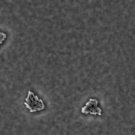
Artificial intelligence could be a valuable tool for the future of food safety. New research out of the University of California, Davis, finds that a technique using AI and optical imaging can quickly and accurately identify bacteria in food, making it a promising approach for preventing foodborne outbreaks and illnesses.

Phaff Yeast Culture at UC Davis Biodiversity Museum Day, Feb. 18th

The Phaff Yeast Culture Collection is participating in the 11th annual UC Davis Biodiversity Museum Day on Saturday February 18, 2023. The yeast displays and activities will be open from 10AM to 2 PM at the Robert Mondavi Institute Brewery, Winery and Food Processing facility. Come explore the exhibits about yeast, hear about the latest discoveries from the Phaff collection, and tour the teaching winery and brewery.

Junior Specialist - Harris Lab

The position of Junior Specialist provides technical or specialized expertise in the planning and execution of research projects in a Biosafety Level II Laboratory. The Junior Specialist stays apprised of the research area and maintains technical competence in the designated area(s) of specialization. The role of this position is to provide specialized expertise in microbial food safety research projects of the laboratory of the Principal Investigators Dr. Linda J. Harris and Erin DiCaprio. The Junior Specialist is actively and significantly engaged in research involving isolation and characterization of foodborne pathogens (Salmonella, shiga toxin-producing Escherichia coli (STEC), and norovirus) from environmental and food samples as part of a project that seeks to understand the prevalence, distribution, and survival of foodborne pathogens in the produce growing environment and in harvested products. The Junior Specialist is responsible for setting up and executing experiments and conducting quality control and data management procedures. The Junior Specialist will have the opportunity to have creative input into the design of and selection of experiments to meet the study objectives. They will also assist with routine day-to-day lab duties including lab safety duties, supplies acquisition, and will lead undergraduate assistants.

Winter 2023 Extension Update

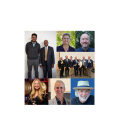
The extension team in the Department of Viticulture and Enology at UC Davis was so happy to finally be able to honor Roger Boulton for his years of service to the university and the wine industry on November 7, 2022. We had close to 200 people in attendance (in person and virtually) at the UC Davis Conference Center. Ted Rieger wrote a great summary of the day which can be found here.

Awards and Announcements

Luis Diaz-Garcia, Assistant Professor, has been named a CAMPOS Faculty Scholar for 2022-23. The Center for the Advancement of Multicultural Perspectives on Science (CAMPOS) was established in 2012 to expand the presence of women and underrepresented faculty in STEM at UC Davis. CAMPOS Faculty Scholars have a clearly articulated vision of how their work at UC Davis will contribute to the University’s mission of serving the needs of the diverse student population which closely reflects the population of the state of California.

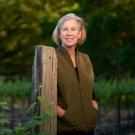
Alumni Profile: Celia Welch

Year and degree of graduation:
I graduated in 1982 with a BS in Fermentation Science. In those days, winemaking and viticulture were considered separate disciplines. Many of the winemakers took the general viticulture class (as I did) but the two areas of study were considered separate disciplines. 

Current job title/company
My current title is Owner/Winemaker at Celia Welch Consulting. 

Course Profile: VEN 170, Wine Regulations

This one-credit course covers regulations in the wine industry, including regulation at the local, state, and federal levels. We cover this material with the help of outside speakers in a seminar style. Topics that are covered include regulation by the Alcohol Tobacco Tax and Trade Bureau (TTB), Alcoholic Beverage Control (ABC), Occupational Safety and Health Administration (OSHA), and the Food Safety Modernization Act (FDA/FSMA), as it applies to grapes and wine.


Student Profile: Alberto Arduino

 Degree/Focus/interest areas:
I am a second-year master's degree student in Viticulture and Enology. My main interest is the chemistry of wine. It just fascinates me. My research topic is focused on grape phenolic extractability and the development of a fast, easy, high-throughput method for its evaluation. 

Where are you from originally?
Turin, Piedmont, Italy 

Welcome to Larly Lee!

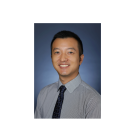
The Department is pleased to welcome Larly Lee as its new Program Coordinator for the Broadening Horizons program. Larly is a Chico State alumnus with a BA in Multicultural and Gender Studies and a MA in Social Science. He is passionate about serving underrepresented and underserved BIPOC communities. Previously, he worked as a K-12 Program Coordinator at the UC Davis School of Medicine, Office of Student and Resident Diversity. He also worked as a TRIO Advisor for the CSU Chico Educational Talent Search program.

Marco on Science Café, December 14th, 2022

FST Professor Maria Marco will be featured on Science Café Wednesday, December 14th, in a conversation with Professor Jared Shaw titled "Eat Your Microbes! What are Fermented Foods and Why Do we Eat Them?" The event is at G Street Wunderbar, 228 G Street, downtown Davis at 5:30 pm.  

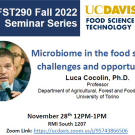
FST 290 Seminar Series - November 28, 2022

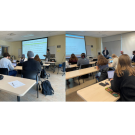
Please join us on Monday, November 28 from 12:10 - 1:00 pm PST, for the last seminar in the Fall 2022 FST290 Seminar Series.  

Professor Luca Cocolin from the University of Torino, Italy will present, ”Microbiome in the food system: challenges and opportunities”.

Spice Containers Are Probably the Dirtiest Items in Your Kitchen?

Just in time for the holidays – a food safety reminder for all home cooks. FST’s Linda J. Harris, in a VeryWellHealth article by Stephanie Brown, “Spice Containers Are Probably the Dirtiest Items in Your Kitchen” recommends making a habit of washing your hands, moving potentially-contaminated items directly to the dishwasher or sink, and cleaning and sanitizing the counters as you cook.