


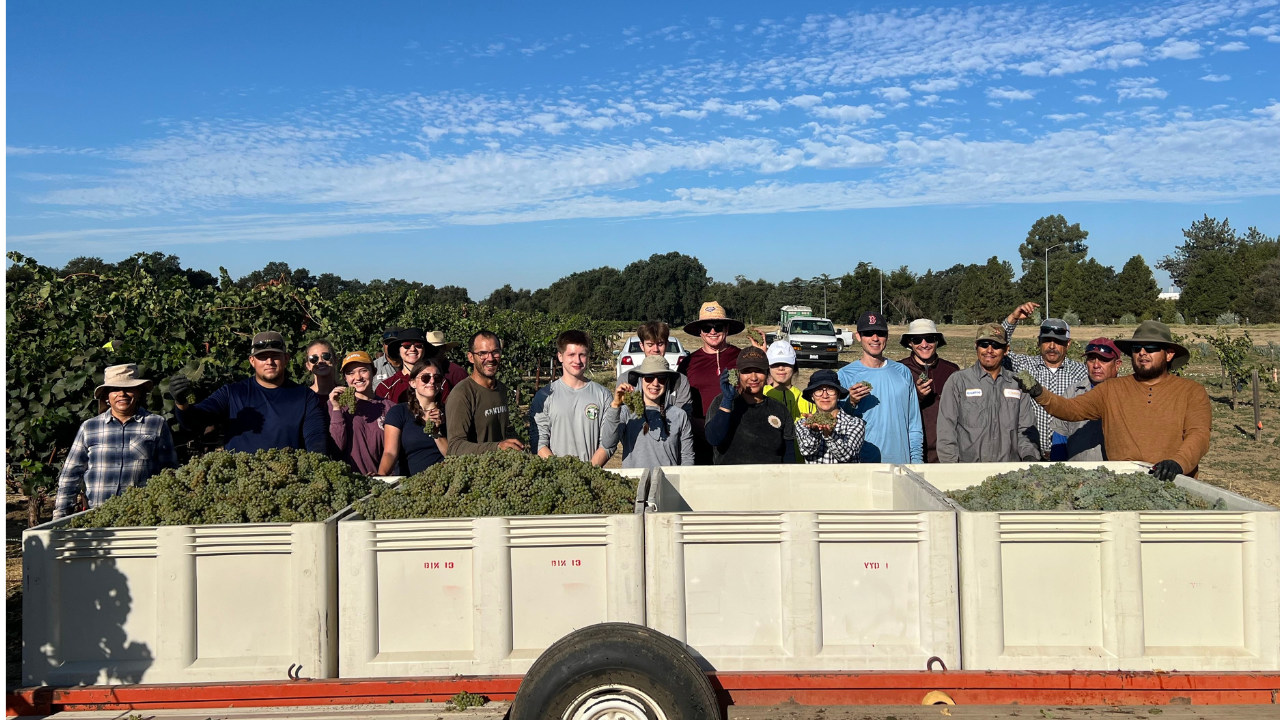
Every harvest brings its own unique season and a wonderful group of students to work with. We are grateful to everyone who contributed this year: staff, faculty, students, researchers, and scholars. Between August 13 and October 16, 2025, we processed 54.4 U.S. tons of fruit across 20 grape cultivars.
Temperatures were lower than average this season, resulting in slower ripening, increased flavor concentration, and greater color intensity, coupled with generally lower and more balanced sugar levels, with better acidity. Early rainfall added challenges for the vineyard team, yet the beauty and variability of nature continue to shape the distinctive sensory profile of the wines we produce, especially when paired with our diverse winemaking practices.

Our interns began the season working as one large team, making decisions collectively, but quickly developed into confident, independent cellar hands capable of managing multiple tasks with efficiency and care. Each pair of interns was assigned a research project to monitor throughout harvest, giving them both ownership and a deeper understanding of the winemaking process. One of the most ambitious projects involved an experiment using 60-TJ fermentors, testing four different fermentation protocols using Cabernet Sauvignon from five vineyards, with an emphasis on phenolic extraction. Through strong collaboration and meticulous attention to detail, the team successfully executed the project.
The winery team demonstrated adaptability and professionalism in maintaining smooth fruit-receiving and processing operations, even when unexpected equipment challenges arose, including the failure of our primary forklift midseason. Seven interns completed forklift certification training, further reinforcing the program’s commitment to safety, technical proficiency, and experiential learning.

One of the major highlights of this year’s harvest, particularly regarding sustainability infrastructure, was the installation of digital water meters throughout the facility. Historically, tracking water use during harvest was labor-intensive and only provided daily resolution. The new meters now capture real-time water use data at both the equipment and zone levels, enabling us to map usage patterns during grape processing, equipment cleaning, and other winery operations. This initiative not only supports the department’s broader sustainability goals but also strengthens our research capabilities by providing operational data to evaluate new cleaning strategies, water-saving technologies, and process automation concepts. The system performed well throughout harvest, and we have already identified analogous technologies to monitor electrical usage across the winery. In alignment with our sustainability goals, all grape pomace and stems were composted, completing the cycle from crush to compost.
Winemaking, much like playing a musical instrument, requires dedication and practice. Much like a symphony, its success depends on the harmony, coordination, and shared commitment of a great team.
We extend our gratitude to the wine industry (wineries and suppliers) for their unconditional support for the success of our harvest.
With so much appreciation,
Leticia, Fermin, Chris, and James☺